When Routine Turns Volatile: What Montana's Traffic Stop Footage Reveals About Preventable Confrontations
Every year, Montana law enforcement officers conduct hundreds of thousands of traffic stops across the state's vast highway network — from the congested corridors of Billings and Missoula to the remote two-lane stretches of Phillips and Petroleum counties. The overwhelming majority of these encounters end without incident. A citation is issued, a warning is given, and both parties go about their day.
But a closer examination of dashboard camera and body-worn camera footage obtained from multiple Montana law enforcement agencies tells a more complicated story. Embedded within the recordings are recurring patterns — predictable, identifiable, and largely preventable moments where routine encounters begin to unravel. Researchers, trainers, and officers themselves say the same mistakes appear again and again, on both sides of the encounter.
MT Police 365 reviewed publicly available footage and spoke with certified law enforcement trainers, traffic safety consultants, and current and former Montana officers to understand what those patterns look like — and what can realistically be done about them.
The First Thirty Seconds: Where Most Encounters Are Won or Lost
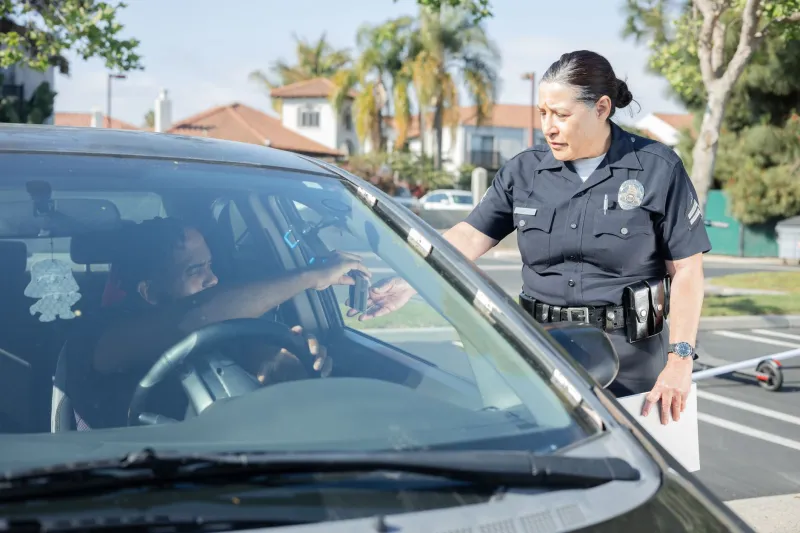
Law enforcement trainers consistently identify the opening moments of a traffic stop as the period of highest risk for miscommunication. According to Craig Halverson, a defensive tactics and de-escalation instructor who has worked with departments across the Mountain West, the window between a patrol vehicle's lights activating and the officer reaching the driver's window sets the psychological tone for everything that follows.
"Drivers are already in a stress response by the time an officer gets to their door," Halverson explained. "Heart rate is up, adrenaline is present, and the brain is operating in a threat-detection mode. If the officer's first words or body language confirm that threat, the encounter is already heading in a difficult direction."
Footage from Montana stops reviewed for this article repeatedly shows drivers making a common and understandable error: reaching — into gloveboxes, center consoles, or jacket pockets — before the officer has had a chance to explain what they need. From the driver's perspective, gathering license and registration in advance seems cooperative. From an officer's vantage point, however, an unseen hand disappearing into a dark compartment registers as a potential threat.
Traffic safety advocates recommend that drivers keep their hands visibly on the steering wheel until the officer arrives and then verbally communicate any movement before making it. "I'm going to reach into my glovebox for my registration" is a simple phrase that can prevent a significant misread.
The Silence Problem: When Not Talking Creates More Tension
One of the more counterintuitive findings from the footage review involves silence. Many drivers, coached by family members or online legal advice, say as little as possible during traffic stops. While there are legitimate legal reasons to limit self-incriminating statements, trainers note that complete non-responsiveness — refusing to acknowledge questions, offering only monosyllabic answers, or staring straight ahead without making eye contact — is frequently interpreted by officers as confrontational or evasive.
Retired Cascade County deputy and current law enforcement consultant Dale Merritt put it plainly: "There's a difference between exercising your rights and being deliberately uncooperative. One of those things is protected. The other one escalates the stop."
Footage reviewed for this article includes multiple examples of stops that began over minor equipment violations — a cracked taillight, an expired registration sticker — and escalated measurably when drivers refused to acknowledge the officer's initial greeting. In several instances, what should have been a two-minute interaction stretched to more than fifteen minutes, with additional units called to the scene.
Legal experts emphasize that drivers are not required to answer questions beyond identifying themselves and providing required documents in Montana. However, they note that a brief, civil acknowledgment — confirming you understand why you've been stopped, or calmly stating that you prefer not to answer questions — is legally distinct from hostile non-engagement.
Officer-Side Patterns: What the Footage Reveals About Procedural Drift
The recordings are not flattering exclusively toward drivers. Trainers who reviewed sample footage for this article identified several recurring officer-side behaviors that contribute to unnecessary escalation.
One of the most frequently cited issues is what Halverson describes as "command stacking" — issuing multiple instructions in rapid succession without giving the driver time to comply with the first. Body camera footage from several stops shows officers asking for license, registration, and proof of insurance while simultaneously asking where the driver is headed, whether they've been drinking, and whether there are any weapons in the vehicle. Drivers who hesitate or ask for clarification are sometimes perceived as being uncooperative, when the more accurate explanation is cognitive overload.
"If you give someone four commands at once and they freeze, that's not defiance," said Merritt. "That's a normal human response to too much information arriving too fast."
A second pattern involves tone calibration. Several recordings show officers beginning stops with language and posture that trainers describe as disproportionately adversarial for the nature of the infraction. A stop initiated for a broken taillight does not carry the same risk profile as a felony vehicle stop, and trainers argue that treating them identically — with a high-alert posture, clipped commands, and minimal explanation — introduces unnecessary friction.
Montana POST (Peace Officer Standards and Training) has incorporated scenario-based de-escalation modules into its training curriculum in recent years, a development that officers and trainers broadly support. However, some instructors note that ongoing reinforcement of those skills — beyond initial certification — remains inconsistent across departments.
The Rural Factor: Distance, Backup, and Elevated Stakes
Montana's geography introduces a variable that urban policing research often overlooks. In counties where the nearest backup unit may be forty minutes away, officers operating alone face a fundamentally different calculus than their counterparts in metropolitan departments. That reality shapes how some officers approach stops, sometimes leading to a more guarded posture that can register as hostility to drivers who are unaware of the context.
Conversely, drivers in remote areas who feel a stop is inappropriate or unsafe may be more reluctant to pull over promptly — particularly at night — given the lack of nearby witnesses or populated areas. Montana law does permit drivers to proceed to a well-lit or populated area before stopping, provided they activate their hazard lights and reduce speed to signal compliance. Officers interviewed for this article acknowledged that many drivers are unaware of this provision, and that the delay is sometimes interpreted as evasion.
Practical Takeaways for Montana Residents
The footage and expert analysis reviewed for this article point toward a set of concrete behaviors that can meaningfully reduce the likelihood of a traffic stop escalating unnecessarily.
For drivers: keep hands on the steering wheel until the officer reaches the window; verbally announce any reaching movement before making it; respond civilly even if you choose not to answer substantive questions; and familiarize yourself with Montana's provisions around stop location and document requirements before you are in a situation where you need them.
For officers and departments: prioritize sequential instruction delivery during stops; calibrate initial posture to the actual risk profile of the infraction; and invest in ongoing de-escalation training that extends beyond initial POST certification.
The footage does not tell a story of malice on either side. What it reveals, consistently and across jurisdictions, is a collision between two parties operating under stress, with incomplete information, and without a shared script for how the encounter should unfold.
That gap is where confrontations are born — and where better preparation, on both sides, has the greatest potential to prevent them.